Dearborn High School
Class Of 1971
DHS History
.jpg)
Source: Dearborn High School 2008 Alumni Directory
****************************************************************************


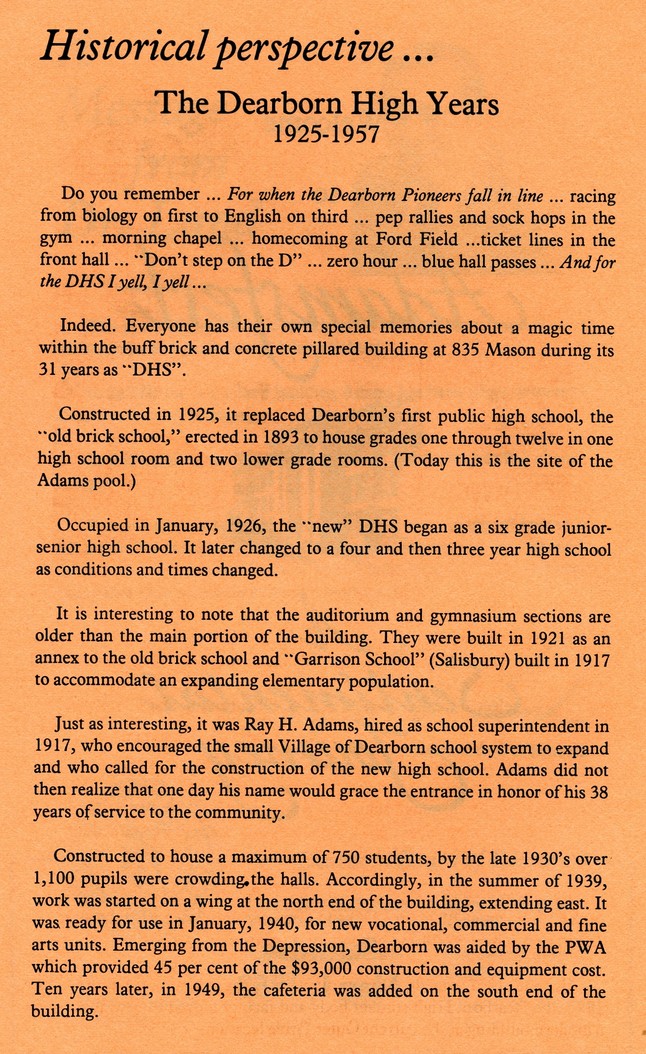
The above photo is remarkable in that it captures the first Dearborn High building (known as the "Old Brick School," built in 1893 and razed in 1925), the Garrison School (later renamed Harry A Salisbury Elementary School, erected in 1917 and still standing), and also Dearborn High School (later renamed Ray H Adams Junior High School, built in 1925 and still standing). Since (1) the photo appears to be taken in winter, (2) the Old Brick School was razed in 1925, (3) Dearborn High School was built in 1925, and (4) both buildings are seen standing in this picture, it was most likely taken circa winter of 1925. .........In addition to the Mason Library (later renamed the Bryant Library) and the Calvin Theater complex (under construction), one can also make out the First United Methodist Church of Dearborn across the street from what was then Dearborn High (and later Adams Junior High).
*******************************************************************************
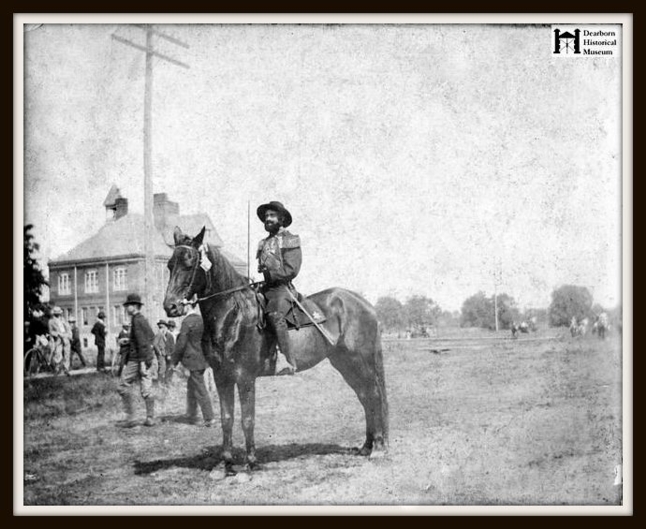
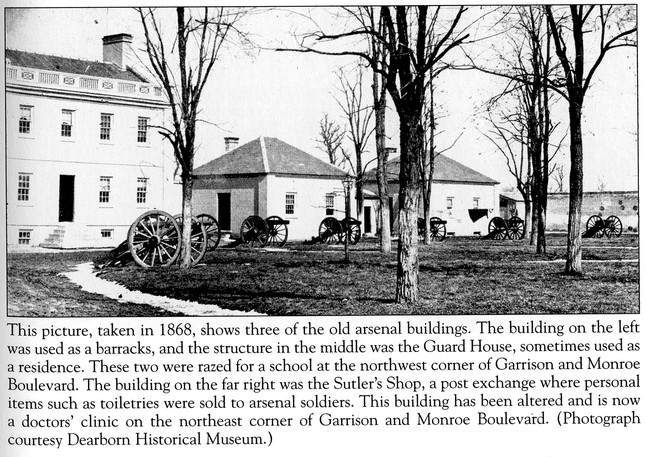
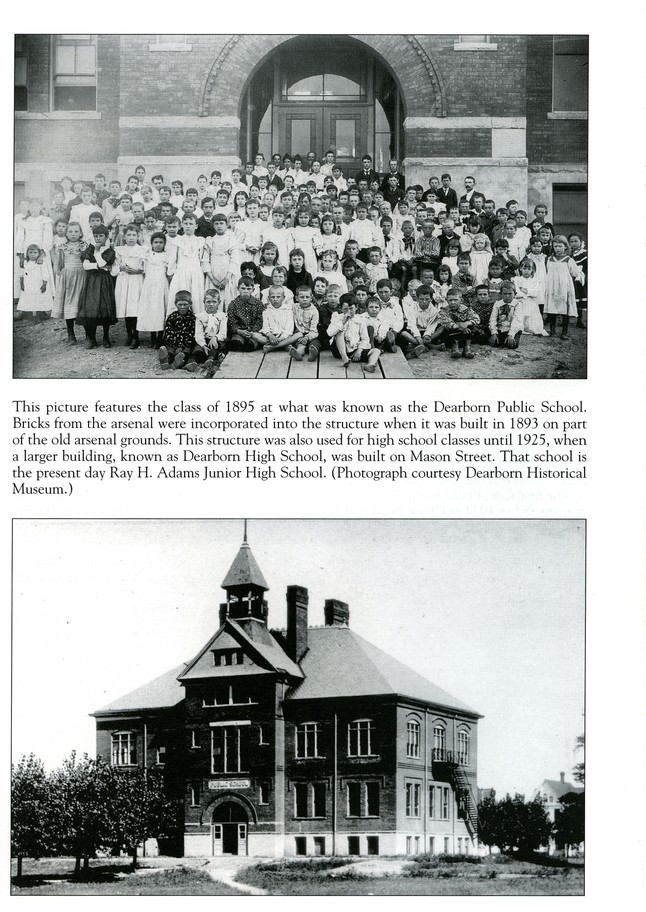
This pic is taken outside the original Dearborn High School built in 1893. The image shows Bernard Magoonaugh (1842-1918) wearing his uniform on the Fourth of July. Bernard served in the Civil War in the Fifteenth United States Infantry. During the firing of a cannon at the Dearborn Arsenal during a service mourning President Lincoln, Private Magoonaugh happened to be in front of the canon when it discharged prematurely and he sadly lost both hands as a result.
****************************************************************************
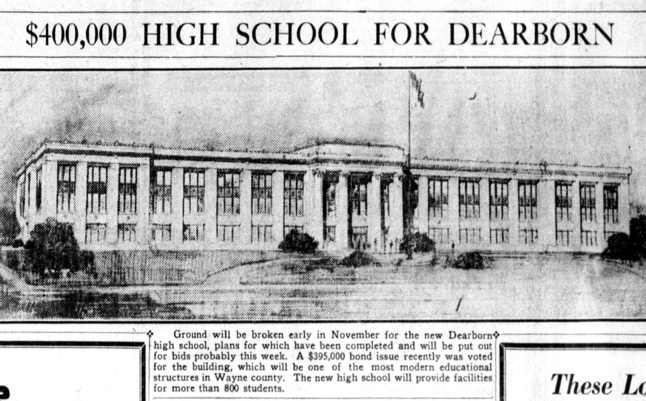
****************************************************************************
.jpg)
**************************************************************************
.jpg)
****************************************************************************
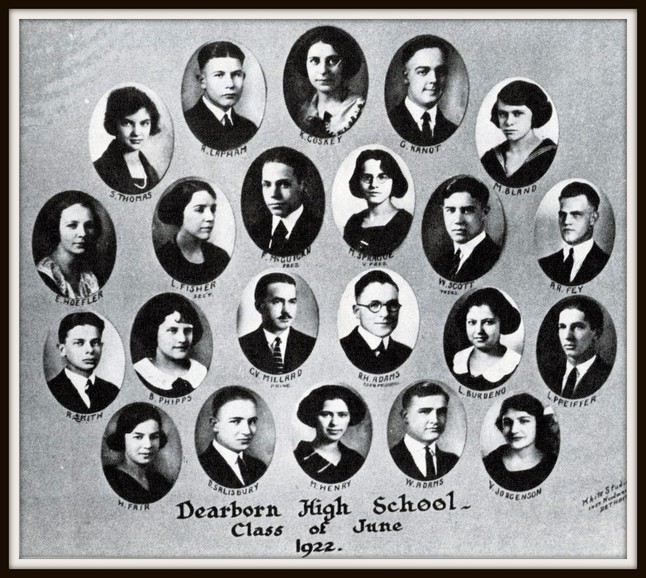
Among memorabilia of old Dearborn High School is this picture of the graduating class of June 1922. In the center of the second row from the bottom are C.V. Millard, Principal, and Ray H. Adams, Superintendent of Schools. Old Dearborn High, located on Mason Street between Morley and Garrison, became Ray Adams Junior High when a new high school was built on Outer Drive. Because of declining enrollments, Adams closed in June 1982. By zooming in on this picture, we can determine that F. McGuigan was the DHS '22 class President, M. Sprague was the class Vice President, W. Scott was the class Treasurer, and L. Fisher was the class Secretary. This class picture appears to have been prepared by White Studio at 1924 Woodward, Detroit. Assuming the entire class is included in the picture, the size of Dearborn High School's graduating Class of June 1922 was 20 (excluding the Principle and Superintendent). The largest graduating class of Dearborn High School was the Class of 1971.....with a graduating class size of 640 (635 June and 5 August graduates). [Photograph courtesy Bill Gemmell]
****************************************************************************
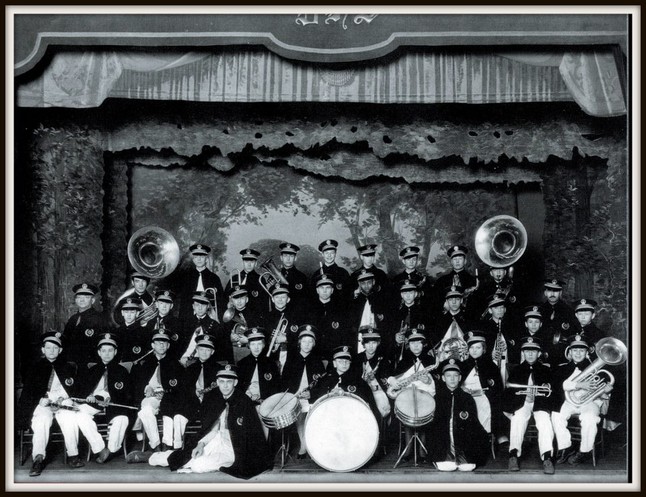
The school band representing Dearborn High around 1928. One can just make out the bottom of the letters, "DHS" - at the top of the stage in this picture. (Photograph courtesy Dearborn Historical Museum)
****************************************************************************
.jpg)
****************************************************************************
****************************************************************************
.jpg)
****************************************************************************


****************************************************************************
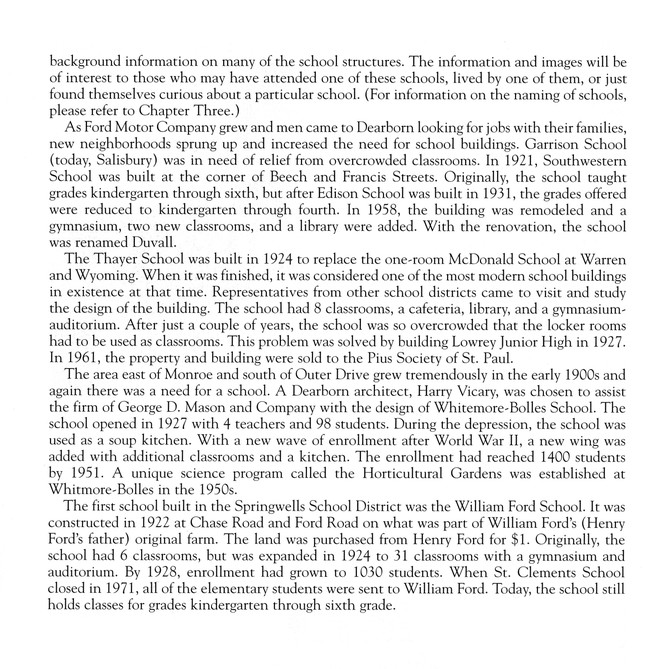
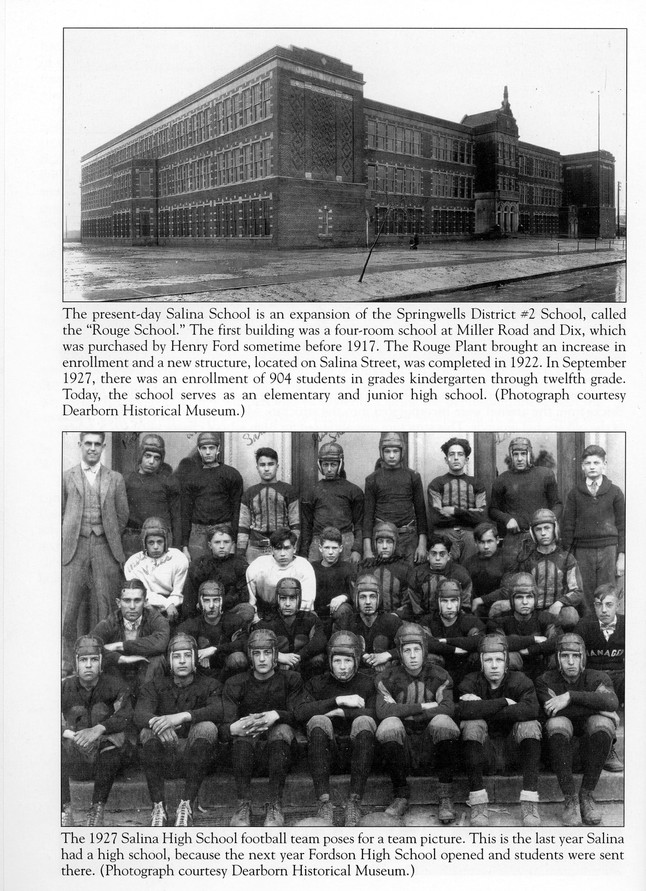
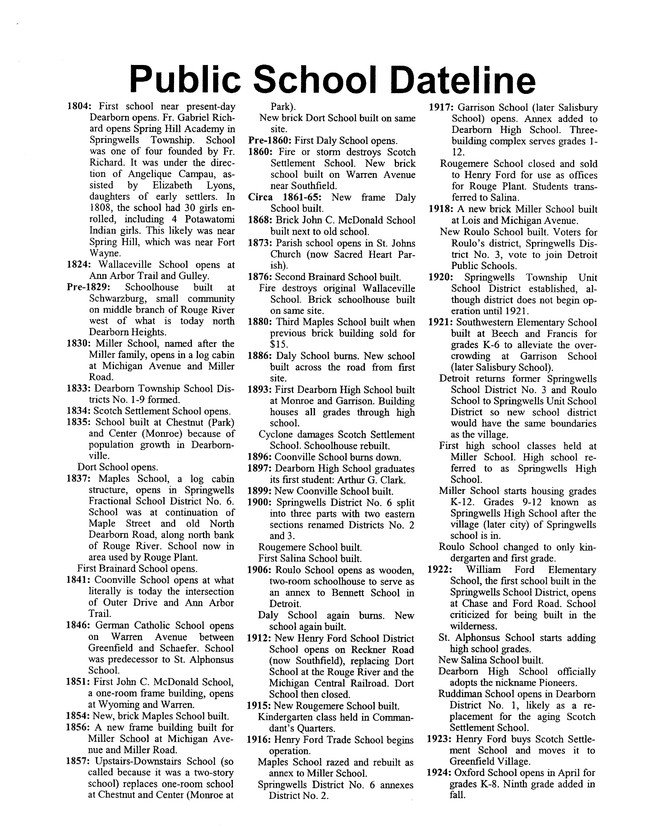
The following historical information concerning our Dearborn public schools (wherein many of us spent a lot of our childhood days) can be found in Chapter 5 of Images of America - Dearborn, Michigan by Craig Hutchison and Kimberly Rising, Dearborn Historical Museum, City of Dearborn, published by Arcadia Publishing, copyright 2003.
Stan
****************************************************************************
.jpg)

*****************************************************************************
.jpg)
.jpg)
.jpg)
*****************************************************************************
The following article was published by The American Local History Network - Michigan. Its author and date are unknown but it must have been written before the early 1970s because it makes reference to Garrison School as "now Salisbury"......but Harry A Salisbury Elementary School ceased to operate as a Dearborn public school in the early 1970s. One unusual aspect of the article is that is does not make any reference to Ora Lynn Smith junior high school (where many DHS '71 classmates went to school). The article's emphasis seems to be more on the founders and construction of various schools than on their enrollment or operations as learning centers. Since this article concerns Dearborn public schools (as do the above articles), no mention is made of well known Dearborn parochial schools such as Sacred Heart, Divine Child, or St. Anselm.
Stan Guinn
*****************************************************************************
Wayne County, Michigan
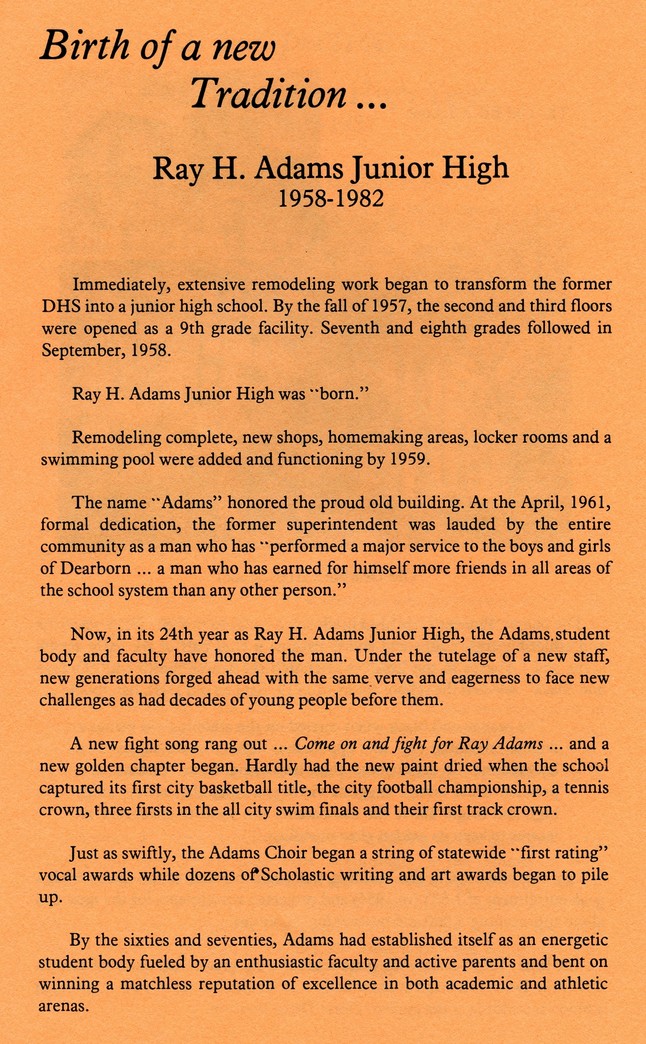
The name was chosen in honor of the former Superintendent of Schools, Ray. H. Adams. In 1917, Adams, came to the Detroit area to seek a teaching position, having had already taught in several other small school districts. He applied and received a reply from Samuel Long, that a vacancy would be available in Dearborn for Superintendent. Adams, had not considered such a position, nor had any interest in the opening. After passing through Dearborn on the train, he had second thoughts. After he arrived in Ypsilanti, Adams came back to Dearborn and was hired as Superintendent. Among the highlights of Adams' career in Dearborn were: the building of six new school buildings, introduction of music and kindergarten to the schools, the establishment of domestic science and printing in the high school, and establishment of art. Ray H. Adams retired in 1958, having served as Superintendent of District Number 7, Acting Superintendent, and Deputy Superintendent of the Dearborn Public Schools and head of the Personnel Department for the schools.
The school building was opened as a facility for grades 6 through 12, and gradually was reduced to a four-year and then a three-year school. The June 1957 class was the last Dearborn High class to graduate from the building. The following September, the school was opened to grades 7th, 8th, and 9th.
Dedicated to Clara Bryant Ford (1866-1951), the wife of Henry Ford the building opened with 771 students in grades 5 through 8.
Clara Bryant, for whom the school was named, was born in 1866 in Greenfield Township, Michigan. She was the oldest of 10 children, being 18 years old when she met, Henry Ford at a New Year's Eve party. Clara was quiet and demure and Henry was serious-minded and shy. They were married at the Bryant home on April 11, 1888. They began their lives as parents, and simple farming people but on September 25, 1891, the Fords moved to Detroit, into a house on John R Street. Their only son, Edsel was born in Detroit in 1893. At first, Henry was employed by the Edison Illuminating Company. However, he was soon interested with a gasoline engine in a brick shed behind his house. This interest, led to working on a new-fangled machine, called the automobile. The rest of Ford's life became history.
Clara remained interested in the social life of the Dearborn community and was the one that started the Garden Club in 1915. She also played a major role in the Dearborn Public Library, located on Mason Street. When her husband, Henry became interested in reviving old-fashioned square dances, Clara could not have been happier.
The school was dedicated only days before her death, and has become a living memorial to a vital member of the Dearborn community.
Conrad Ten Eyck came to Detroit from New York in 1802. He was ambitious and by 1814 owned a general store in Detroit, was a land agent and had become a prominent Michigan political figure. Ten Eyck moved to Dearborn in 1823, long before the first wave of settlers and built the Ten Eyck Tavern in 1826 along old Chicago Road. The tavern was often filled to capacity and thousands of westward bound travelers boarded here. When the first railroad came through Dearborn in 1837, the amount of travel by wagon and stage decreased rapidly, and the tavern closed. A fire in 1885 burned the building which was then used for the storage of grain.
Ten Eyck died on August 23, 1847, at the age of 65 years. His sons inherited his large land holdings and these were later sold to Henry Ford and later formed the base area of the Fair Lane Estates.
Clark became well known in Dearborn when he advocated the construction of a new brick schoolhouse on the corners of Garrison and Monroe Streets. The land, was at that time, part of the Detroit Arsenal tract, and was given as a grant in 1891. The school housed all of the district’s students from 1st grade through high school, in seven rooms starting in 1893. William Clark became so prominent in local affairs that he was selected as the first Village President in 1893.
In the late 1940s, during the expansion of schools in West Dearborn, many pioneering families were discussed for the naming of a new school. The William H. Clark School was selected and a new school building was located on Silvery Lane and Lawrence Streets that began in March 1950. The school was to be five rooms, with a completion date of September 1950. The school was designed to resemble a one-story ranch house, quite unusual, for any school design in the communities past. Clark opened to 225 students in grade kindergarten through 3rd, in January 1951, to relieve the overcrowded, Haigh School, nearby. In the summer of 1954, four more classrooms were added, and it was operated by the same principal as Haigh.
Due to a decline in enrollment, Clark closed in June 1976, and the building was not used for any other purpose.
In 1958, Southwestern was remodeled as well as renamed. The PTA suggested it be named in honor of the principal of the school, who had held this position since 1928, named, Leo DuVall. They added a gymnasium and two new classrooms, as well as expanding the kindergarten and adding a library.
Leo DuVall came to Dearborn from Deckerville, Michigan in 1928 to become the school's principal (then named, Southwestern). In those days a principal was more than just the manager of a school building. He had to be the Child Accountant during the Depression years, and was responsible for the location of children during the school year. He was also in charge of transportation for the Dearborn Schools. With large and scattered districts, many students were bussed-in, and DuVall was responsible for the placement at each school. In addition, he served as the system's purchasing agent, and submitted a budget and list of materials needed to run each school, at the lowest prices as possible. In June, 1959, DuVall retired as principal, having served over 30 years.
Edsel became working on the development of the Ford Motor Company's Rouge Plant in 1912, which in turn led to the expansion of the growth within the city of Dearborn. As a pioneer in the field of airplane manufacture, Ford supported the development of the Ford Tri-Motor Company which was active in the administration of the bomber plant at Willow Run. Following his untimely death in 1943, it was fitting that a modern, school be named in his honor.
Edsel Ford High School is a unique school, in the planning had begun 5 years before the actual construction. A planning committee was named, Edsel Ford Staff Planning Committee to meet with architect from 1951 through 1953 planning layouts of the building.
The Fund for the Advancement of Education, a division of the Ford Foundation, provided a six month study program for 27 teachers at the University of Chicago as well as an additional two years of follow-up to develop a new curriculum. Following World War II, educators changed the direction of curriculum from a vocational one, to a more general attitude. They placed more emphasis on the Humanities and college preparatory courses, and many of the programs pioneered at Edsel Ford High School are now a standard part of the curriculum of high schools across the United States.
The building was constructed in 1955, for 1,440 students with additional space added in 1960. The school is still open and has active enrollment today.
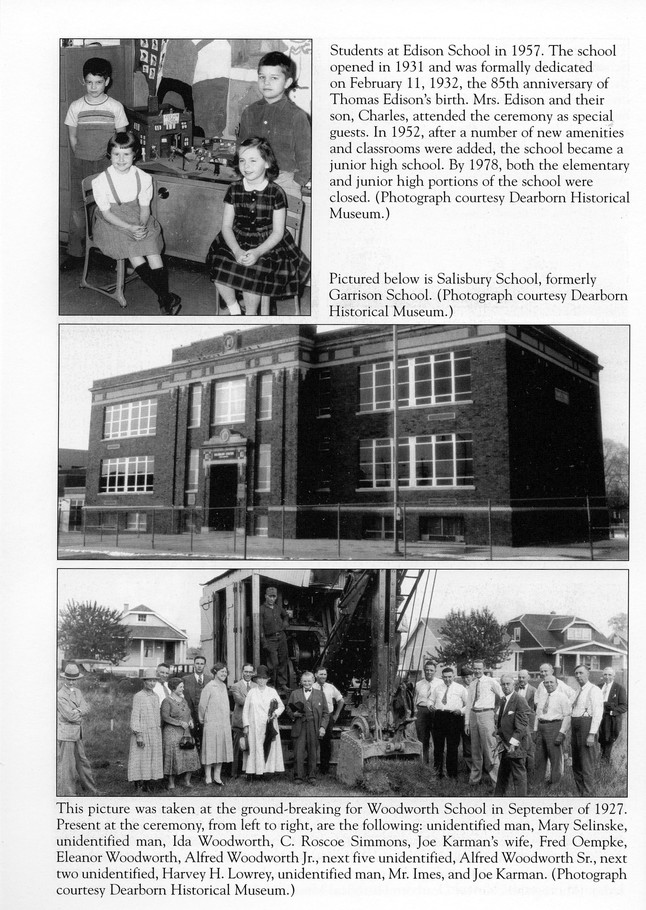
Edison School opened on January 26, 1931, with an enrollment of 289 students and principal, Raymond Good. It was formally dedicated on February 11, 1932, the 85th anniversary of Thomas Edison's birth. Attending were, Mrs. Edison and their son, Charles, as special guests.
By 1940, eight classrooms were added as were grades 7th, 8th, and 9th. In 1952, Edison became a Junior High school and 36 classrooms were added, including a new gymnasium, cafeteria, a home economic room, an art room, a new auditorium, expanded library, a band and choral room, and an audio-visual room. In 1953, they added a swimming pool. By 1976, the elementary portion of the school closed and by 1978, the Junior High was closed as well.
After World War II, the population of this area expanded, and in 1949, a bond issued by the Coonville district along with a millage increase from construction of a new school was passed. The property on which the previous schools had stood, was now the intersection of Ann Arbor Trail and Outer Drive, as the new school was built on the northwest corner of that intersection. This school was named in honor of Clara Bryant Ford and in 1950, the name of the Coonville District #2, was changed to the Fairlane School District, again in honor of the Ford family, who owned land in the area. By 1952, the district had grown and an additional seven new classrooms, were added, as well as a junior high, renamed, in 1956 to Fairlane Middle School.
By March 1971, Fairlane ceased to be an independent school district and was used as a 6th through 9th grade facility by the Dearborn Public Schools, until June of 1977. This was later remodeled and reopened as a branch of the Henry Ford Community College, Dearborn Heights Center, in September 1978.
The rapid growing community of Fordson, encouraged the Ford Motor Company's Rouge Plant to build the school on a 15 acre plot of ground in the center of the city. Prior to the building of Fordson High School all children grades kindergarten through the 12th for Fordson and Springwells areas, were attending Miller School, located on Lois Street, which was built in 1918.
The official dedication of Fordson High School took place the week of March 19th through March 23rd, 1928. 2,000 Junior and Senior High School students occupied the school during its first years. The school administrative offices were eventually moved to Miller School in 1967.
Among the major changes over the past 75 years, the addition of music rooms and the enlargement of its gymnasium facilities have cost 8.5 million dollars, and have caused the most controversy in its entire history.
Fordson High School remains in its serene and calm setting on Ford Road in the City of Dearborn and was recently established as a historical landmark.
In 1926, the white frame school had become too small to accommodate the growing community and a new brick building containing 5 classrooms, a boiler room, two offices, and an auditorium, were constructed on Driscoll Avenue. By 1929, the school had expanded to 16 classrooms, shop facilities, a kindergarten, a music room, swimming pool, library, gymnasium, cooking and sewing rooms, and science laboratories. It was accommodating grades kindergarten through Junior High, and had an enrollment of 515 students.
Henry Ford also provided land for garden plots and its earlier frame school was converted during World War II into a canning factory to process food raised in the garden. He also had students take dancing lessons as well as hired a nurse, doctor, and a dentist for the school.
In 1942 the Henry Ford School District consolidated with Fordson School District and in 1954, it became part of the Dearborn Public Schools. Today the school serves grades kindergarten through the 6th grade.
Henry A. Haigh was born in Dearborn in 1854. The son of Richard and Lucy Haigh, he remained one of the community's favorite citizens until his death in 1942. He was educated at the Michigan State University and the University of Michigan, and was a well known farmer, financier, promoter, speaker, lawyer, and writer. As a businessman, he was interested in the railroad industry and founded lines from Detroit to Cincinnati, Ohio, as well as local lines from Detroit to Ypsilanti. He was also known as a local historian and formed the Dearborn Historical Commission, which led to the establishment of the Dearborn Historical Museum. Haigh kept a diary, of each day from his enrollment to the Michigan Agricultural College in 1875 until his death in 1942. This diary has become one of Dearborn's most outstanding historical contributions from this time frame.
The renaming of York School to Joshua Howard in 1949, was part of the expansion of the Dearborn Public Schools. During this prosperous time in Dearborn's history a total of 14 new schools had been built in the area, and the school naming committee was busy submitting names from the recesses of Dearborn’s pioneers. Colonel Joshua Howard was sent to Dearborn as a supervisor of construction for the Detroit Arsenal at Dearborn Ville in 1832. Howard quickly became involved in the growing community and built one of the finest homes in Dearborn in 1834. The house was located on Old Chicago Road (now Michigan Avenue) where the Dearborn Towers now stand today. In addition to his duties as an officer with the U.S. Army Corps of Engineers, Howard served as a United States Marshal.
Howe was named in honor of Louis W. Howe, one of Dearborn's pioneers. Louis Howe, was the son of Elba Howe, a station agent for the Michigan Central Railroad in Dearbornville, and the community’s first undertaker. Born in 1873, in Dearborn, he served as township clerk and treasurer and then village clerk and treasurer after the incorporation of the Village. He was personally responsible for conducting the 1900 census in Dearborn and served on the school board from 1918 to 1924, was a charter member of the Dearborn Rotary Club and served as a Master of the Masonic Lodge. Howe followed his father, serving as a volunteer fire chief, an insurance salesman, and a funeral director. His wife, Jennie Clark, was the daughter of William Clark, by whom the Clark School was named.
David P. Lapham was born in Dearborn in 1851. The Lapham family owned a 100 acre farm on what is currently the site of Military and Monroe Streets. David established the first bank in Dearborn in 1896 and sold it to Henry Ford in 1916. The family operated a general store and butcher shop, and David served on Dearborn's Board of Education, when the first high school was built. Lapham died in 1926 in Birmingham, Alabama, having been injured by falling lumber in an accident in Pensacola, Florida.
Dedication for the school building was held inside the building itself in the library, however Colonel Lindbergh was not present, his mother did attend as guest of honor. Despite the depression years, the area around the school did continue to grow and additions were proposed for the school in 1938. The school was expanded to 16 classrooms as well as an auditorium and gymnasium. In 1948 additional property was also purchased to enlarge the playground area. In 1954, the last addition was made on the structure, and the school continues to educate the areas Elementary and Junior High students.
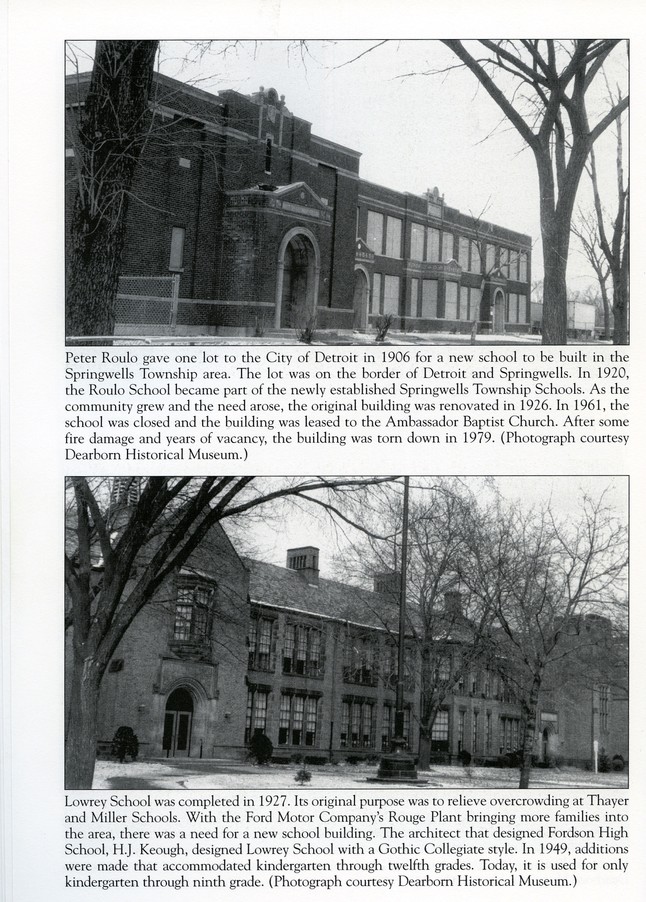
Designed by H.J. Keough, the architect who also designed Fordson High School, used a Gothic Collegiate style, and made the building large enough to accommodate grades kindergarten through 9th. The school also housed a complete library , cafeteria, and fully equipped orthopedic department, which was designed for all students including the handicapped. Additions were made in 1949, and the school was incorporated into a High School as well as its Elementary and Junior High. From 1949 to 1969, the school was used for all three grade levels, however today it is used only for grades kindergarten through 9th.
Harvey H. Lowrey was hired as Superintendent of the Springwells Township School District in February 1922, and served in that capacity until his retirement in 1946. He was also a teacher for over 50 years, having started that career in 1896 at Berlin Center, near Ionia, Michigan. He also served as principal of Saranac High School, Superintendent of Pewamo High School and Commissioner of the Ionia County Schools. Lowrey then became Registrar and a teacher at Mt Pleasant Normal College. (now Central Michigan University). He resigned to complete his doctoral degree at the University of Michigan, Ann Arbor. In 1922, he came to the Springwells School District as Superintendent. Here he served on the Charter Commission in 1924 and again in 1942. He retired and left the Dearborn area, and passed away in 1961 at the age of 82.
Fred Maples was born on May 16, 1873, in the family home located in the area of what is now, Schaefer and Rotunda. His grandfather came to the Springwells area in 1829 and settled in a log cabin on the banks of the Rouge River. They had been farmers, but they also kept a tavern on Ann Arbor Road (now the location of the Rouge Plant). Fred Maples married in 1897 to Catherine Campbell and settled in the village of Springwells. He soon became involved in both commercial and residential real estate. He served on the Fordson Board of Education, and was well known of his work with charities. Maples died suddenly on June 5, 1931.
William Nowlin was one of Dearborn's first pioneers. They came to Dearborn in 1834 when William was 13 years old. The Nowlin farm was located in what is today both Dearborn and Dearborn Heights, but at that time, was Dearborn Township. William Nowlin authored the book, The Bark Covered House, a firsthand account of Dearborn's pioneer life , written in 1876. Nowlin married twice; first to a neighbor, Adelia Travis, and following her death in 1882, he married Anna Crandell. He had three sons, however, none of them were interested in farming, and sold the Nowlin farm. There is also a Nowlin Cemetery located on what was a portion of the same farm, now on Van Born Road, with Nowlin family members buried there.
Between the 1930 and 1960 Roulo served the community but by 1961 it was closed. The City of Dearborn purchased the property in 1962 and it was leased to the Ambassador Baptist Church. In 1972 a fire damaged the building which was torn down in 1979, after years of vacancy.
Despite the depression of the 1930's enrollment did continue in the area, however Salina was then only needed for grades kindergarten through 9th. Additions were made in 1951 and 1958, and Project Head Start, a program to prepare kindergarteners of school, was started here in 1965. The school continues to serve the community as an Elementary and Junior High School.
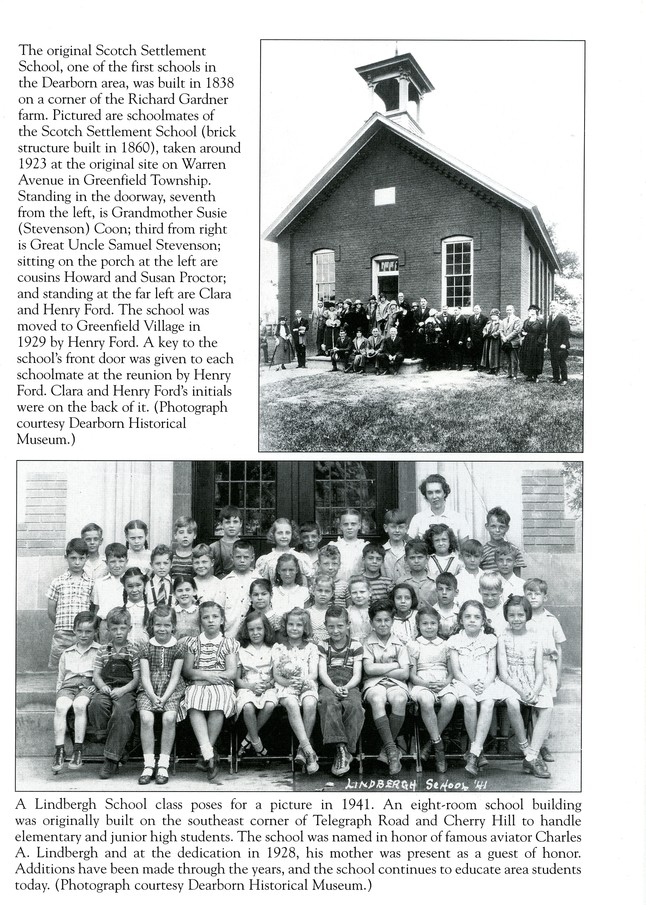
The Scotch Settlement School was the school for Dearborn Township District #1, which included what are today portions of Dearborn and Detroit. The name, "Scotch Settlement" was a local term for an area bounded by Joy Road on the north, Ford Road on the south, the Rouge River on the west and Roulo Creek on the east. The first settler here was Richard Gardner, in 1828, followed by the Kirks, Leslies, Ruddimans and Stevensons all from Scotland. The community remains farmland until Henry Ford began to change the nation’s ideas of industry and transportation. In 1923, Henry Ford purchased the Scotch Settlement School and moved it to the Edison Institute (now the Henry Ford Museum and Greenfield Village).
The school was incorporated into the Village of Dearborn School System, and was used as a school from 1929 to 1969, when the system closed. The most notable teacher during its "Village period" was, E. Lucile Webster.
It now serves as an educational resource for the area, known as the "one-room schoolhouse."
Edward S. Snow was born in 1820, in Austinburg, Ohio. He was one of eight children and he attended the local "common" school. In 1838, Snow enrolled at the Grand River Institute in Austinburg where he took a course in surveying. Before he could accept a position by the government as surveyor in the Northwest Territory, a close friend became ill, and Snow stayed behind to care for him. This experience interested him in medicine and in 1847 he graduated from the medical department at Western Reserve College in Cleveland, Ohio. He married in 1851 to Elizabeth Austin and he was requested to fill in for Dr. Markham in Plymouth, Michigan temporarily. When Snow arrived in Dearborn, he and his wife settled in the Dearborn Hotel. He served as physician and surgeon at the Detroit Arsenal in Dearbornville until it closed in 1875. He was also a surgeon for the Michigan Central Railroad for 43 years. The Snows were one of Dearborn's first citizens and members of the Christ Episcopal Church. He served as school inspector for Dearborn Township and his name is honored by Snow Street, Snow Hill Apartments, and Snow Woods , as well as Snow School.
William Bushnell Stout, was an American aviation pioneer. He was born on March 16, 1880, in Quincy, Illinois. His family relocated to St Paul, Minnesota where Stout attended Mechanical Arts High School and the University of Minnesota. He financed his education by writing articles on his mechanical toy inventions. In 1906 he married Alma Raymond and built their first home, and all of their furniture. He was made an aviation and technical editor for the Chicago Tribune in 1912 and became affiliated with the Scripps-Booth Automobile. He redesigned the Scripps-Booth car and in 1914 was transferred to Detroit, as Chief Engineer for the company. In 1919 he formed the Stout Engineering Laboratories for aeronautical engineering, and built the first American commercial monoplane, the Batwing. It was at this same time that he met, Henry Ford and learned that both, Henry and Edsel Ford were also interested in aviation. Through this affiliation, the Ford Airport on Oakwood Boulevard was developed in 1924-1925 (currently the site of the Ford Motor Company's test track). In 1926 the famous tri-motor plane, was developed and Stout made his mark in aviation history.
At the time that Thayer School was built, it was considered one of the most modern buildings of its kind. Representatives from other school districts came to visit the building and study its plan for use. The original construction was 8 classrooms, a cafeteria, library and gymnasium-auditorium, and opened in September of 1924. By 1926, the school was so crowded that both its locker rooms had to be used as classrooms. This overcrowding was alleviated with the building of Lowrey Junior High. The school changed very little over the years, and closed in 1959. In 1961 the property and building were sold to the Pius Society of St. Paul.
During the Depression of the 1930's the school was used as a soup kitchen and after the Second World War a new wave of growth came to Dearborn. In 1940, an additional wing was added, including 8 more classrooms and a kitchen. By 1951, enrollment reached 1,400 students. One of the unique science programs established here in the 1950's was the Horticultural Gardens.
The school name Whitemore-Bolles, honors two of Dearborn's families; J. E. Bolles, the donor of the original site and Laura Whitmore, who was also the niece of William Nowlin. When Mrs. J. Bolles donated the land she asked the school be named in honor of both her family (the Whitmores) and her husband's family (the Bolles).
William Ford, after whom the school is named, came to the United States from Ireland in 1847 with his parents, grandmother, and six brothers and sisters. The family settled in the Scotch Settlement (today approximately the area of Ford Road, Greenfield, Joy Road, and Southfield Roads) and joined Samuel Ford, who was William's uncle. After arriving they found that Samuel had died but that his two sons had prosperous farms in the same area. The Ford's purchased land in the adjoining corners of Redford, Greenfield, Springwells, and Dearborn Townships. William helped his father on the farm as well as working for Michigan Central Railroad. When the railroad was completed, William returned and worked on the Patrick O'Hern farm. The O'Herns adopted a daughter, Margaret Litogot, who married William in 1861. In 1863, their second child and first son was born, Henry in a house they shared with the O'Hern family. William Ford served on the local school board and was a respected member of the community until his death in 1905, at that age of 79.
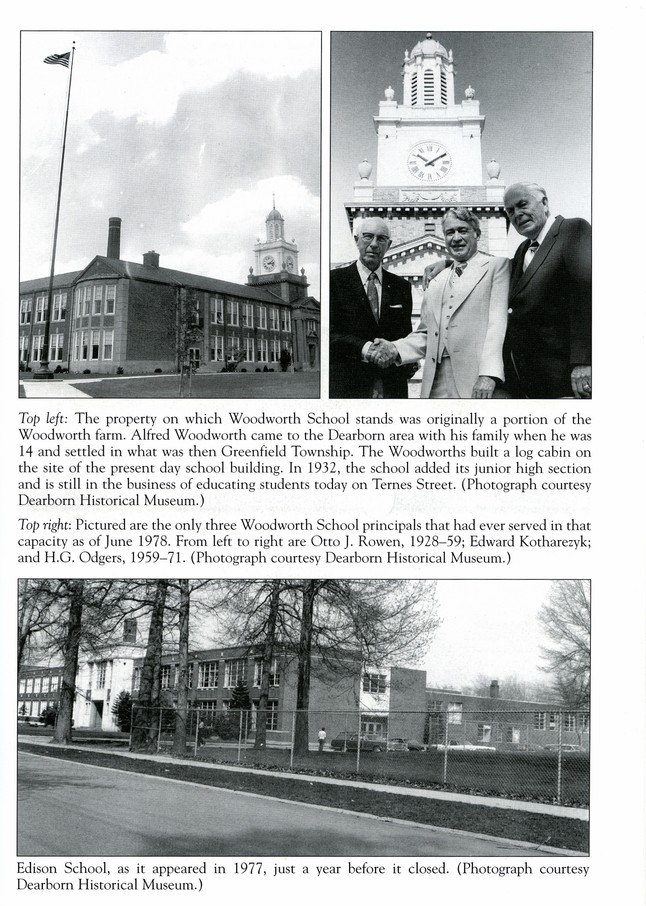
As a small boy, he came with his father, Josiah, and other members of the Woodworth family to Batavia, New York in an ox-drawn wagon. At the age of 10, Alfred was bound out to work for four years, and when his four years were completed he joined his family on a move to Michigan. The Woodworth's settled in Greenfield Township and purchased 48 acres of land and built a log cabin home on the site of the present day school building. Alfred also purchased land in 1840 and continued to buy land in this vicinity until his farm totaled 245 acres. He married in 1843 to Phoebe Jane Smith and had nine children. Alfred died in 1904 and is buried at the Scotch Settlement Cemetery.
The first cornerstone for Woodworth School was laid in September of 1927 and was opened the following September as a kindergarten through 6th grade school. In 1932 the school added its Junior High school section, and in 1937 a swimming pool, larger cafeteria, music rooms and a small auditorium. In 1940, the Fordson Board of Education purchased additional property to the west for a playground. The school is still currently open and houses grades kindergarten through 8th grades.
Dearborn School Namesakes
(Note: Some schools were named for entire local pioneer families: Brainard, Coonville, Daly, Dort, Miller, Roulo, Thayer, Whitmore, Bolles, etc.)
Ray Adams: Longtime Dearborn school superintendent.
Lafayette Allen Sr.: Believed to be the first African American in the country to open, own and operate his own supermarket.
Iris Becker: Longtime Dearborn schoolteacher and city activist.
Oakley W. Best: Longtime District 7 superintendent.
Clara Bryant: Henry Ford’s wife.
William H. Clark: First president of the village of Dearborn 1893-95.
Leo DuVall: Longtime principal of his namesake school.
Thomas Edison: Famed inventor and close friend of Henry Ford.
Fred C. Fischer: Superintendent of Wayne County Schools 1946-54.
Edsel B. Ford: Henry Ford’s lone son.
Henry Ford: (See above.)
William Ford: Henry Ford’s father.
Clara B. Ford: Henry Ford’s wife.
Henry A. Haigh: Active early citizen and considered city’s first historian.
Col. Joshua Howard: First commander of the Detroit Arsenal. Howard is credited with suggesting the name Dearborn for this area.
Louis B. Howe: Early active citizen and politician.
David B. Lapham: Established Dearborn’s first bank in 1896, a precursor to today’s Comerica Bank.
Charles A. Lindbergh: Famed aviator and one of few schools in Dearborn or Dearborn Heights named for someone with no direct local connection.
Samuel B. Long: Longtime director of Dearborn Board of Education and early settler.
Harvey Lowrey: Longtime school superintendent 1922-46.
Fred C. Maples: Popular Fordson school board member and civic leader.
George T. Martin: Longtime Dearborn judge and valedictorian of Fordson’s first graduating class.
John B. McDonald: Member of pioneer family of east Dearborn.
Leslie J. McNair: World War II hero killed in action.
John L. Mokersky: Longtime Dearborn Township and Dearborn Heights Justice of the Peace.
William A. Nowlin: Early settler, author of “The Bark Covered House,” written for nation’s centennial in 1876 depicting early life here.
Robert Oakman: Early land developer in northeast Dearborn and west Detroit.
Hamilton J. Robichaud: Longtime superintendent of Dearborn District No. 8 (Westwood).
Franklin D. Roosevelt: Former president of the United States.
Harry A. Salisbury: Longtime teacher, principal of Dearborn High School.
Ora Lynn Smith: Longtime active Dearborn school attorney and civic leader.
Edward Snow: Early physician and civic leader.
William B. Stout: Early aviator and founder of Stout Air Services, designer of famed Ford Tri-Motor plane.
Conrad Ten Eyck: An early settler here, he operated a tavern in the early 1800s at Michigan Avenue and the Rouge River. It was a regular stop for travelers heading to and from Detroit. The state’s nickname, Wolverines, is credited with being coined at his saloon.
William Thorne: Longtime township clerk and state representative.
John H. Tomlinson: Popular Dearborn District 8 (Westwood) school board treasurer.
John Wallace: Early landowner who donated original building and land for first Wallaceville School in 1824.
Edith Wellever: Longtime teacher at Brainard School.
Albert Woodworth: Member of pioneer farmer in east Dearborn..